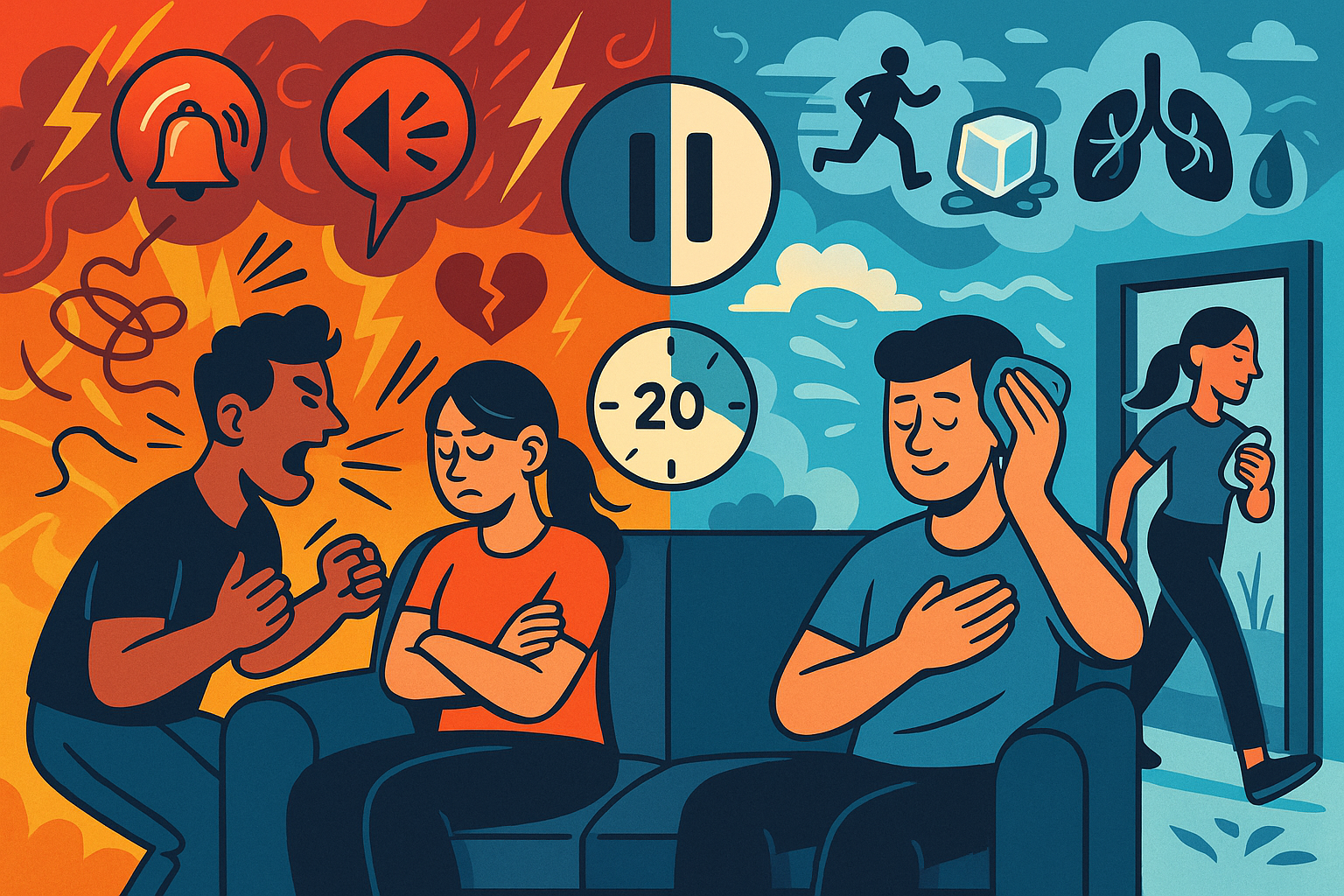
Hi everyone, Dr. Love here. Over my decade as a relationship psychologist, I’ve sat with hundreds of couples and individuals. And if there’s one pattern I’ve seen derail more promising connections than any other, it’s this: you have a disagreement, and within minutes, it escalates. Voices rise, defenses go up, and suddenly you’re not talking about the dishes in the sink anymore. You’re re-litigating a fight from six months ago. One partner shuts down completely, while the other gets louder, trying to break through the wall. In the end, nothing is resolved, and both of you are left feeling hurt, misunderstood, and exhausted.
If this sounds familiar, you’re not alone. The problem isn’t that you’re “bad communicators” or that you don’t love each other enough. The problem is that you’re getting emotionally hijacked. Today, we’re going to move beyond the useless advice to “just calm down” and dive into the science of what’s happening in your brain and body during these moments. More importantly, I’m going to give you a set of practical, evidence-based tools—worksheets you can actually use—to start regulating these intense emotions and building a relationship that feels safe, connected, and resilient.
Why “Just Calm Down” Is the Worst Advice: Understanding Emotional Flooding
Have you ever been in a conflict where your heart starts pounding, your breathing gets shallow, and you can’t think straight? You might feel an overwhelming urge to either lash out or run away. This physiological and psychological state has a name: Emotional Flooding. Coined by world-renowned relationship researcher Dr. John Gottman, it describes what happens when your nervous system gets overwhelmed by a perceived threat—often an emotional one, like criticism or contempt from your partner.
Think of your brain’s prefrontal cortex—the part responsible for rational thought, problem-solving, and empathy—as your company’s CEO. When things are calm, the CEO is in charge, making thoughtful decisions. But during emotional flooding, your body is flooded with stress hormones like cortisol and adrenaline. Your heart rate can shoot above 100 beats per minute. This triggers your brain’s “fight-or-flight” response, and your amygdala—the brain’s smoke detector—hijacks the system. The CEO is kicked out of the office, and the security guard is now running the company. In this state, it’s physiologically impossible to listen, empathize, or problem-solve effectively. All you can do is react: attack (fight) or withdraw (flight).
Recognizing emotional flooding isn’t a sign of failure; it’s a crucial act of self-awareness. It’s your body’s signal that you need to pause and self-soothe, not push through a conversation that has become unproductive.
This is why trying to resolve a conflict when one or both of you are flooded is like trying to perform delicate surgery during an earthquake. It only makes things worse. The first and most critical skill is learning to recognize the signs of flooding in yourself and your partner and agreeing to take a break.
Your Emotional Blueprint: How Your Past Shapes Your Present Reactions
So why do some people get flooded more easily than others? The answer often lies in our past. According to Attachment Theory, our earliest relationships with caregivers create an “internal working model” or a blueprint for how we navigate relationships and regulate emotions throughout our lives. This blueprint is formed before we can even speak; it’s an emotional language we learn in infancy.
- Secure Attachment: If your caregivers were consistently warm, responsive, and available, you likely developed a secure attachment. You learned that emotions are manageable, that it’s safe to express your needs, and that connection is a reliable source of comfort. As an adult, you’re more likely to have a balanced approach to emotional regulation.
- Anxious Attachment: If your caregivers were inconsistent—sometimes available, sometimes not—you may have developed an anxious attachment. You learned to amplify your emotional signals (a strategy called hyper-regulation) to get your needs met. As an adult, you might be highly sensitive to perceived threats of abandonment and feel your emotions very intensely.
- Avoidant Attachment: If your caregivers were distant, rejecting, or discouraged emotional expression, you may have developed an avoidant attachment. You learned that showing emotion leads to punishment or withdrawal of love, so you learned to suppress your feelings (a strategy called hypo-regulation). As an adult, you might pride yourself on being independent and self-sufficient, but you may shut down or withdraw during conflict to avoid feeling vulnerable.
Understanding your attachment style isn’t about blaming your parents. It’s about understanding your own programming with compassion. It helps explain why you react the way you do, and it’s the first step toward consciously choosing new, more effective responses.
From Reactive to Responsive: A Practical Toolkit for Emotional Regulation
Emotional regulation is a skill, not a personality trait. Like any skill, it can be learned with practice. In my work, I draw from powerful, evidence-based therapies like Dialectical Behavior Therapy (DBT) and Cognitive Behavioral Therapy (CBT) to build a multi-layered toolkit. Think of it as an emotional first-aid kit, with different tools for different levels of distress.
Level 1: Daily Maintenance (Building Your Emotional Immune System)
The best way to handle a crisis is to prevent it. These skills reduce your baseline vulnerability to emotional overwhelm. I teach all my clients the DBT skill of PLEASE:
- PL – Treat Physical Illness: Chronic pain or illness drains your emotional resources. See a doctor when you need to.
- E – Eat Balanced Meals: Blood sugar spikes and crashes directly impact your mood.
- A – Avoid Mood-Altering Drugs: Use alcohol and other substances in moderation, if at all.
- S – Sleep Adequately: Sleep deprivation is a major driver of emotional dysregulation.
- E – Exercise: Physical activity is one of the most powerful mood regulators available.
This might seem basic, but I can’t tell you how many relationship conflicts are fueled by one partner being hangry or exhausted. Tending to your physical well-being is non-negotiable for emotional health.
Level 2: Managing the Rising Tide (When You Feel It Coming)
You feel your frustration growing, but you’re not flooded yet. This is the golden window to intervene before the hijack happens. Here are two powerful skills:
- The STOP Skill: This is a crucial mindfulness practice to create a pause between an emotional trigger and your reaction.
- S – Stop! Just freeze for a moment. Don’t do or say anything.
- T – Take a step back. Take a deep breath. Create some mental space.
- O – Observe. What are you feeling in your body? What thoughts are running through your mind? What is the other person saying?
- P – Proceed mindfully. What is your goal here? What action will make the situation better, not worse? Choose your response intentionally.
- Check the Facts: Our emotions are often triggered not by an event itself, but by our interpretation of the event. Ask yourself:
- What is the event that triggered my emotion? (e.g., “My partner came home late.”)
- What are my interpretations and thoughts about this event? (e.g., “They don’t care about me. They’re being selfish.”)
- Am I confusing thoughts with facts? Is there another, more generous interpretation? (e.g., “Maybe they got stuck in traffic or had a long day at work.”)
- Does the intensity of my emotion match the actual facts?
Level 3: Crisis Survival (When You’re Already Flooded)
If you’ve missed the window and you’re already flooded, cognitive skills won’t work. Your CEO is offline. At this point, the goal is not to solve the problem, but to tolerate the distress without making things worse. This is where you need physiological “reset” buttons. The DBT skill TIPP is brilliant for this:
- T – Temperature: The fastest way to calm your nervous system is to trigger the “dive reflex.” Hold your breath and splash your face with cold water, or hold an ice pack on your cheeks and eyes for 30 seconds. This immediately slows your heart rate.
- I – Intense Exercise: Do 60 seconds of intense cardio, like jumping jacks or running in place. This helps your body expend the “fight-or-flight” energy.
- P – Paced Breathing: Slow your breathing way down. Breathe in for a count of 5 and out for a count of 7. The long exhale signals safety to your nervous system.
- P – Paired Muscle Relaxation: Tense a muscle group as you inhale, then relax it completely as you exhale. Work your way through your body, from your toes to your face.
Remember, when you’re flooded, you must take a break of at least 20 minutes to allow the stress hormones to leave your bloodstream. Use that time to do a TIPP skill, go for a walk, or listen to calming music—anything that is distracting and soothing.
Putting It All Together: Your First Emotional Regulation Worksheet
Knowledge is great, but practice is what creates change. I’ve designed a simple worksheet based on these principles to help you start building your skills. The next time you feel a strong, difficult emotion, take a few minutes to walk through these steps. Don’t do it in the middle of a fight—practice with small, everyday frustrations first.
| Step | Guiding Question & Action |
|---|---|
| 1. Identify the Emotion | What am I feeling right now? Be specific (e.g., not just “bad,” but “disappointed,” “ashamed,” “frustrated”). Rate its intensity (1-10): ______ |
| 2. Identify the Trigger | What just happened (externally or internally) that prompted this feeling? Write down the facts of the situation. |
| 3. Check Your Thoughts | What stories or interpretations am I telling myself about this trigger? Are these thoughts facts or opinions? Is there another way to see this? |
| 4. Choose a Skill | Based on my intensity level, what skill do I need right now? Low Intensity (Maintenance): Did I follow my PLEASE skills today? Medium Intensity (Rising Tide): Can I use the STOP skill or Check the Facts? High Intensity (Flooded): I need to take a 20-minute break and use a TIPP skill. |
| 5. After-Action Check-In | After using the skill, what is my new intensity level (1-10)? ______ What did I learn from this experience? |
Conclusion: Building a Relationship That Can Weather Any Storm
Learning to regulate your emotions is one of the most profound gifts you can give yourself and your relationship. It’s not about suppressing feelings or avoiding conflict. It’s about creating enough internal space to respond to life’s challenges with wisdom, intention, and compassion, rather than reacting from a place of fear or pain.
This journey starts with a single step: awareness. Start noticing your emotional patterns without judgment. Use the worksheet to get curious about your inner world. Be patient with yourself and your partner. You are unlearning patterns that have been in place for decades. But with consistent practice, you can move from being controlled by your emotions to being the conscious, loving architect of your life and your relationships.
I’d love to hear from you. What’s one small step you can take this week to practice emotional regulation? Share your thoughts and experiences in the comments below.