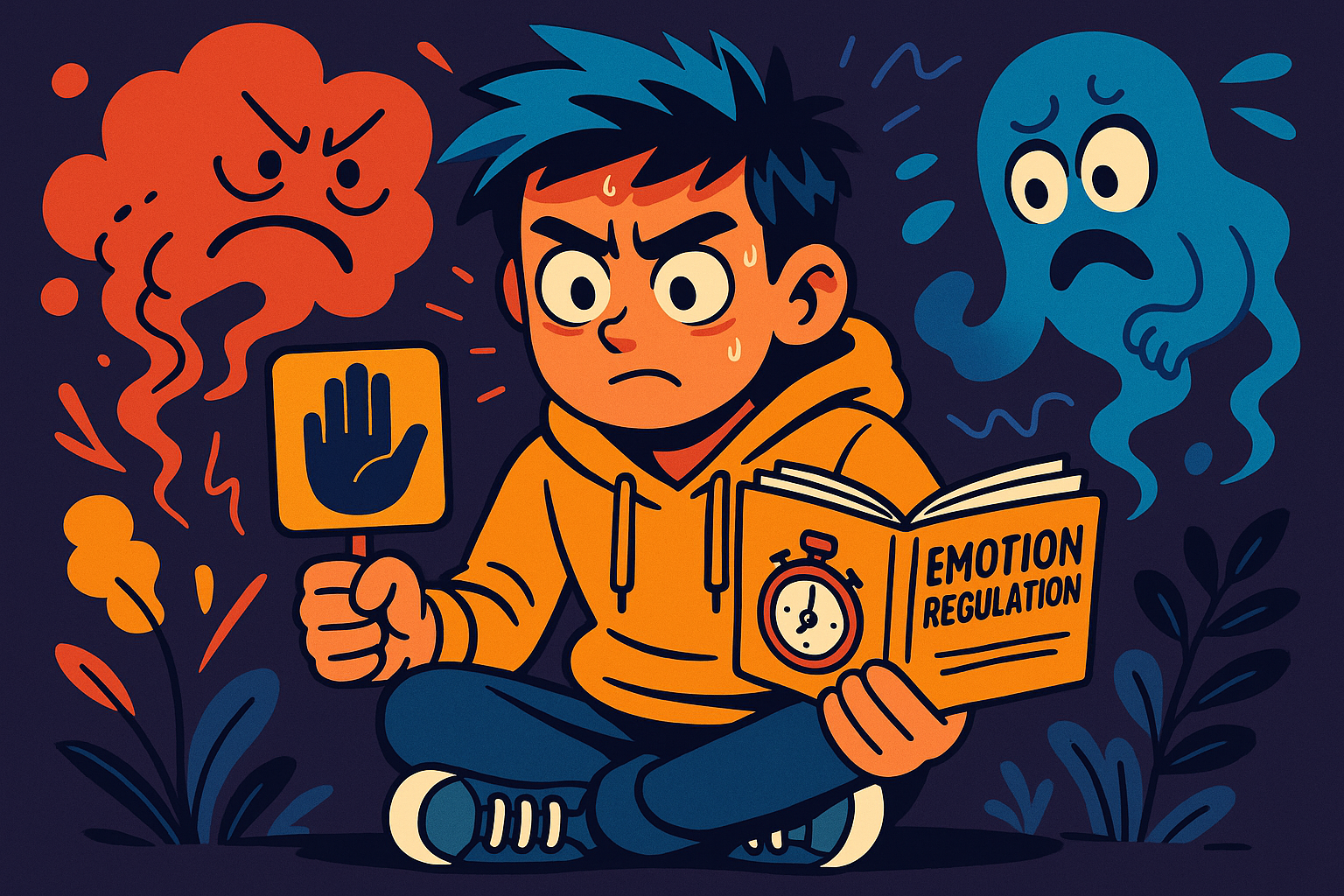
Mastering Emotional Regulation: A Teen’s Guide
Hey everyone, Dr. Love here.
Have you ever found yourself in a full-blown rage over a misplaced phone charger? Or felt a wave of anxiety so intense about walking into a party that you just… didn’t go? If you’ve nodded yes, I want you to know two things: first, you are not alone. And second, you are not broken. In my decade of working with individuals on building stronger selves and relationships, I’ve seen this pattern countless times, especially during the teenage years. It’s a period of intense feelings, and it often feels like our emotions are in the driver’s seat, taking us on a wild, unpredictable ride.
But what if I told you that this emotional intensity isn’t a flaw? What if it’s actually a feature of a brain that’s undergoing one of the most incredible upgrades of its life? Let’s get under the hood and understand what’s really going on, and then I’ll share some of the most effective tools from my practice to help you grab the steering wheel.
Why Does Everything Feel So Intense? Your Brain on ‘Upgrade Mode’
I often use a car analogy with my clients to explain the teenage brain. Imagine your brain is a high-performance race car. During your teen years, the emotional engine—a powerful, fast-reacting part of the brain called the amygdala—is fully turbocharged. It’s responsible for those gut reactions, big emotions, and the powerful drive for social connection and reward. It’s your gas pedal, and right now, it’s incredibly sensitive.
Meanwhile, the sophisticated braking system—the prefrontal cortex, located right behind your forehead—is still being installed. This is the part of your brain that handles logic, planning for the future, understanding consequences, and controlling impulses. It’s a complex system that won’t be fully calibrated and online until you’re in your mid-20s.
This “developmental mismatch”—a powerful gas pedal and still-developing brakes—is the core reason why everything feels so intense. It’s why the sting of being left out by friends can feel catastrophic, why the thrill of a new crush is all-consuming, and why it’s so hard to resist the impulse to send that angry text. Your brain is temporarily wired to prioritize immediate emotional and social feedback over long-term consequences. But here’s the empowering part: this isn’t a bug in the system. Your brain is in “super-learning mode,” optimized to explore, adapt, and learn from your social world. You’re not out of control; you’re under construction.
Your Emotional First-Aid Kit: A Quick Guide to What to Do When
When you’re in the middle of an emotional storm, it’s hard to remember what to do. That’s why I created this simple “First-Aid” chart for my clients. It connects a feeling to a specific, actionable skill. Think of it as your emergency cheat sheet.
| When you feel… | Your Go-To Skill | Try This Immediately |
|---|---|---|
| Overwhelmed, on the verge of panic | DBT Distress Tolerance Skills | The TIPP Skill |
| Stuck in a loop of negative thoughts | CBT Cognitive Restructuring | A Thought Record |
| Furious, about to explode | DBT Crisis Survival Skills | The STOP Skill |
| Feeling “off” but can’t name why | Mindfulness & Grounding | The 5-4-3-2-1 Method |
Skill #1: Hit the Brakes with the STOP Skill
Imagine you’re about to say something you’ll regret in an argument, or fire off that angry text. Your emotions are screaming GO! This is the moment to slam on the brakes. The STOP Skill, from a powerful therapy called Dialectical Behavior Therapy (DBT), is your behavioral emergency brake.
- S – Stop. Literally, freeze. Don’t move a muscle. Don’t speak. This physical pause creates a crucial gap between your emotional impulse and your action.
- T – Take a step back. Take a deep breath. If you can, physically take a step back from the situation or put your phone down. Give yourself a moment of space.
- O – Observe. What is actually happening, both inside and outside of you? What are you feeling in your body? What did the other person actually say? Gather the facts like a neutral reporter, without judgment.
- P – Proceed Mindfully. Now, ask yourself: What is my ultimate goal here? What action will make this situation better, not worse? Based on that goal, choose your next move deliberately, instead of letting the emotion choose for you.
Skill #2: Reboot Your System with TIPP
Sometimes, you’re past the point of thinking. You’re in a 10/10 emotional crisis—a panic attack, a fit of rage, overwhelming despair. In these moments, trying to reason with your brain is like trying to type on a computer that’s frozen. You need a hard reboot. The TIPP Skill is designed to do just that by rapidly changing your body’s chemistry.
- T – Temperature. Splash your face with cold water, or hold an ice pack on your cheeks and eyes for 30 seconds while holding your breath. This triggers a natural calming response in your body called the “mammalian dive reflex,” which quickly slows your heart rate. (Note: If you have any heart or medical conditions, please consult a doctor before trying this).
- I – Intense Exercise. Got a huge surge of angry or anxious energy? Burn it off. Do jumping jacks, run up and down the stairs, or sprint down the block for a few minutes. Match the intensity of your emotion with intense physical effort.
- P – Paced Breathing. Slow your breathing way down. The key is to make your exhale longer than your inhale. Try breathing in for a count of 4 and out for a count of 6. This activates your body’s relaxation system.
- P – Paired Muscle Relaxation. Tense a group of muscles (like your fists) as hard as you can while you breathe in, and then completely relax them as you breathe out. Notice the feeling of tension melting away. Work your way through different muscle groups in your body.
Skill #3: Become a Thought Detective with CBT
Once the emotional storm has calmed from a red-alert crisis to a more manageable yellow-alert, you can start using your thinking brain again. This is where we can become “thought detectives.” A cornerstone of my practice is Cognitive Behavioral Therapy (CBT), which is based on one profound idea: it’s not events themselves that cause our feelings, but our thoughts about those events.
Often, our minds fall into unhelpful thinking traps called “cognitive distortions.” Here are a couple of common ones:
- Catastrophizing: Your mind jumps to the absolute worst-case scenario. “I failed this test, so I’ll fail the class, I’ll never get into college, and my life is ruined.”
- All-or-Nothing Thinking: You see things in black-and-white terms. “If I’m not the best player on the team, I’m a total failure.”
The key is to catch these thoughts and challenge them. A simple Thought Record can help.
Your Mini Thought Record
- The Situation: What actually happened? (e.g., “My friend didn’t reply to my text for three hours.”)
- My Automatic Thought: What was the first thing that popped into my head? (e.g., “They’re mad at me. I did something wrong.”)
- My Feeling: What emotion did that thought create? (e.g., Anxiety, sadness.)
- Challenge It: What is the evidence *against* this thought? Are there other possible explanations? (e.g., “They said they were busy today. Their phone could be off. They’ve done this before and it was nothing.”)
- Create a Balanced Thought: Write a new, more realistic thought. (e.g., “It’s possible they’re just busy. I can’t know for sure why they haven’t replied, and jumping to conclusions is just making me anxious.”)
From Surviving to Thriving: Regulation as a Social Superpower
Here’s the real magic, and the core of what we do here at LovestbLog: mastering your inner world fundamentally transforms your outer world. Emotional Regulation isn’t just about feeling less bad; it’s about *connecting* better. When you can pause before reacting, you stop yourself from saying hurtful things in arguments with your parents or your partner. When you can manage your own anxiety, you can show up for a friend who needs you without getting overwhelmed yourself. You learn to express your needs clearly instead of exploding with frustration.
These skills are the foundation of healthy, resilient, and deeply fulfilling relationships. By practicing them now, you are not just getting through your teen years—you are actively building the emotional architecture for a lifetime of strong connections.
Your Turn to Build
Remember, your brain is not your enemy; it’s a powerful work in progress. These tools aren’t about getting rid of emotions—they’re about learning to navigate them skillfully. Like any skill, it takes practice. You won’t be perfect, and that’s okay. The goal is progress, not perfection.
So, I’ll leave you with a question to start your journey. What’s one emotional trigger you regularly face, and which tool from this kit are you most curious to try next time it shows up? Share your thoughts in the comments below. Let’s build this skill together.
With warmth and encouragement,
Dr. Love