Fun Emotional Regulation Activities for Kids
Hi, I’m Dr. Love, founder of LovestbLog. I’ve spent over a decade helping individuals and couples build stronger, healthier relationships, and one of the most profound truths I’ve learned is this: our ability to connect with others is forged in the crucible of how we first learned to connect with ourselves. And that education begins in childhood, often during the most chaotic moments—like a full-blown, on-the-floor, kicking-and-screaming tantrum over a broken cookie.
We’ve all been there. Your child’s emotional dial is cranked to eleven, and your first instinct is to say, “Calm down!” or “Stop crying!” It feels logical. But in my experience, telling a dysregulated child to “calm down” is like telling a person caught in a rainstorm to “get dry.” It’s not only ineffective; it completely misses the point of what’s happening inside their developing brain.
Why “Calm Down” Is the Worst Thing to Say to a Child in a Meltdown
Imagine your child’s brain has two key parts: a highly sensitive “smoke detector” (the amygdala, or emotional brain) and a thoughtful “fire chief” (the prefrontal cortex, or thinking brain). When a big emotion like anger or frustration hits, the smoke detector goes off—loudly. In that moment, the fire chief is completely offline. There’s no logic, no reasoning, no impulse control. There’s only a five-alarm fire of feeling.
When we command them to “calm down,” we’re trying to reason with a fire chief who has already left the building. This is why the concept of emotional regulation is so misunderstood. It’s not about suppressing or “controlling” emotions.[1, 2] It’s about giving our children the tools to notice the smoke, hear the alarm, and eventually, learn how to call the fire chief back to the station. It’s a skill, built over time, not an instruction to be followed in the heat of the moment.
The goal isn’t to stop the emotional fire; it’s to become the calm, steady firefighter who shows up to help, teaching them how to handle the heat until they can do it themselves.
The Secret Weapon You Already Have: Becoming an Emotion Coach
So, if you can’t talk them out of a tantrum, what can you do? You use the most powerful tool in your parenting arsenal: yourself. This is a process called co-regulation. Think of yourself as your child’s external nervous system.[3] When their internal world is a chaotic storm, your calm, steady presence acts as a safe harbor, helping them ride the waves until they subside.[3, 4]
This isn’t just a nice idea; it’s rooted in interpersonal neurobiology.[3] Through thousands of these moments, you are literally wiring your child’s brain for resilience and secure attachment.[3] You are the training wheels for their self-regulation.
The most effective framework for this comes from the brilliant work of Dr. John Gottman, who identified a parenting style he calls the “Emotion Coach.” An Emotion Coach sees a child’s negative feelings not as a problem to be fixed, but as a golden opportunity for connection and teaching.[5]
Here’s a quick look at the different parenting styles Gottman identified:
| Parenting Style | Core Belief | Impact on Child |
|---|---|---|
| The Dismissing Parent | Negative emotions are trivial and should disappear quickly. | Learns their feelings are wrong or invalid; has difficulty regulating emotions.[5] |
| The Disapproving Parent | Negative emotions are a sign of weakness and must be controlled. | Same as dismissing, but with added feelings of shame.[5, 6] |
| The Laissez-Faire Parent | Accepts all emotions but offers no guidance or limits on behavior. | Doesn’t learn to regulate emotions; struggles with impulse control and friendships.[5, 7] |
| The Emotion Coach | Negative emotions are an opportunity for connection and teaching. | Learns to trust their feelings, regulate emotions, and solve problems; has higher self-esteem.[5, 8] |
Becoming an Emotion Coach involves five key steps [6, 9]:
- Be aware of your child’s emotion. Notice the subtle cues before the storm hits.
- Recognize the emotion as an opportunity for intimacy and teaching.
- Listen with empathy and validate their feelings. This is the magic step. “It sounds like you’re so angry that your tower fell.”
- Help your child label their emotions with words. Giving a feeling a name tames it.
- Set limits while helping them problem-solve. “I know you’re mad, but hitting is not okay. What’s a better way to show your brother you’re upset?”
Your “Emotional First-Aid Kit”: Differentiating Brain-Down vs. Body-Up Strategies
Now for the practical magic. To be an effective Emotion Coach, you need the right tools at the right time. The most critical distinction I teach parents is the difference between “brain-down” (top-down) and “body-up” (bottom-up) strategies.
- Brain-Down Strategies are cognitive. They involve talking, reasoning, and problem-solving. They engage the “fire chief” (the thinking brain).
- Body-Up Strategies are sensory. They involve movement, breathing, and physical sensations. They calm the “smoke detector” (the emotional brain) directly.
Here’s the rule: You cannot use a brain-down strategy when a child is in a body-up crisis. When the smoke alarm is blaring, you must first calm the nervous system. Only then can the fire chief come back online to talk about what happened.
The Fun Part: Your Go-To List of Regulation Activities
Think of these activities as your emotional first-aid kit. When your child is dysregulated, reach for a Body-Up tool. When they are calm and connected, practice the Brain-Down skills.
Body-Up Activities (For Calming a Nervous System in Overdrive)
These activities provide sensory input that is naturally organizing and calming to the brain.
- Heavy Work (Proprioceptive Input): These activities involve pushing, pulling, and deep pressure, which sends calming signals to the nervous system. Think of it as a weighted blanket for the brain.[10, 11]
- Animal Walks: Have them stomp like an elephant, crawl like a bear, or walk like a crab.[12, 13] This provides powerful input to the muscles and joints.
- Pillow Pile Crash: Let them safely crash into a big pile of pillows or cushions.[13] It’s a fantastic way to release physical tension.
- Pushing Games: Have them push a laundry basket full of toys across the room or play a gentle game of tug-of-war.[13]
- Breathing and Grounding: Slow, deep breaths are the fastest way to manually switch the nervous system from “fight or flight” to “rest and digest.”
- Dragon Breathing: Breathe in through your nose, then open your mouth and roar the “fire” (your breath) out.[14] This is perfect for releasing anger.
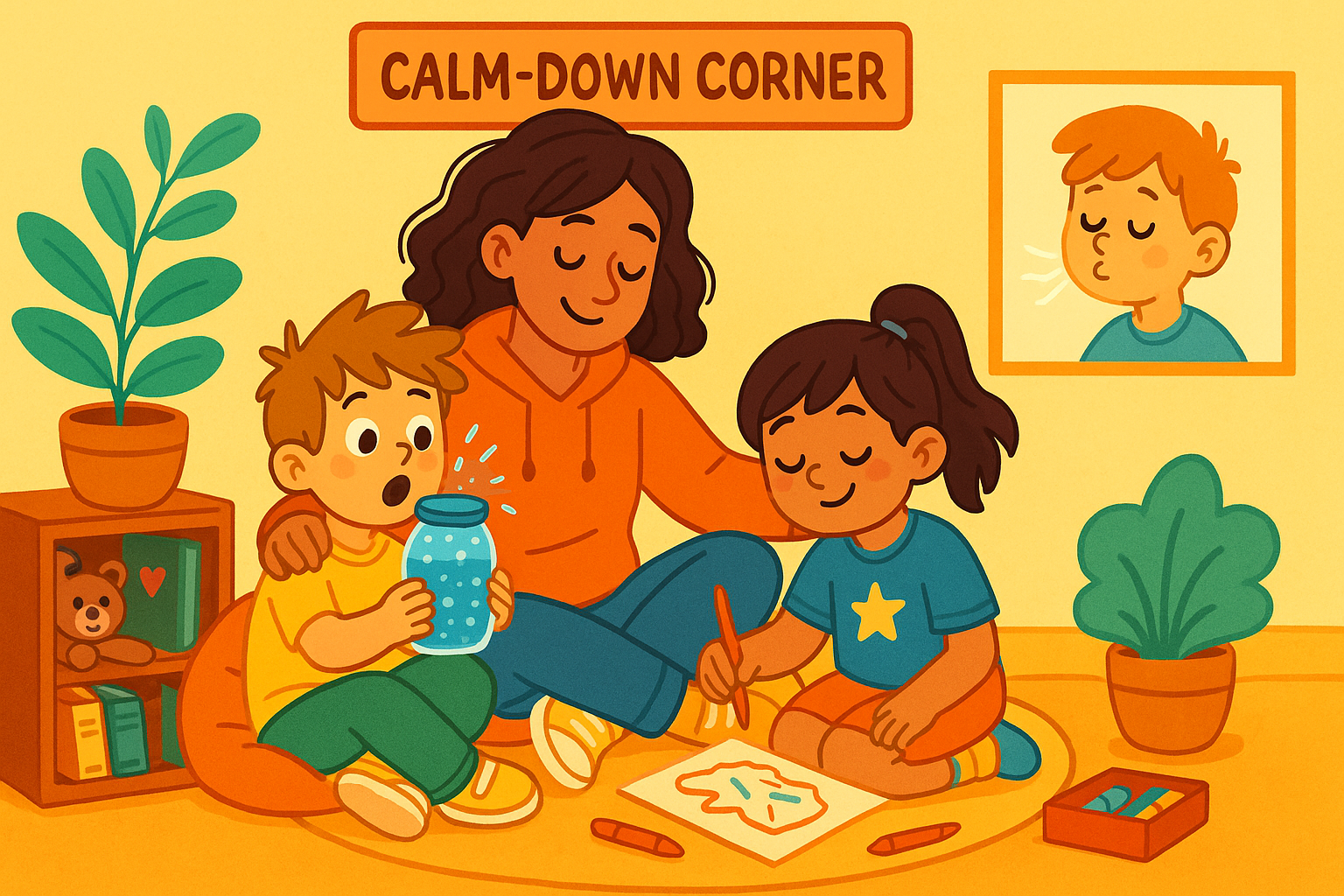
- Calm-Down Glitter Jar: Shake up a bottle filled with water, glue, and glitter. As you watch the glitter slowly settle, it provides a visual metaphor for a busy mind calming down.[14, 15]
- The 5-4-3-2-1 Grounding Game: When anxiety is high, pause and name: 5 things you can see, 4 things you can feel, 3 things you can hear, 2 things you can smell, and 1 thing you can taste.[16, 17] This pulls their attention out of the internal storm and into the present moment.
Brain-Down Activities (For Building Skills When Calm)
Practice these when your child is regulated and receptive. This is where the learning and skill-building happen.
- Creative Expression: Art provides a safe, non-verbal outlet for feelings that are too big for words.
- Painting to Music: Play different kinds of music (fast, slow, loud, soft) and have them paint what the music makes them feel.[14, 18]
- Scribble and Tear Art: Give them a piece of paper to scribble all their angry feelings onto. Then, let them rip it into tiny pieces and use the pieces to create a new collage.[19] This transforms destructive energy into something creative.
- Movement and Play: Play is the language of childhood, and it’s a fantastic way to practice essential regulation skills.
- Freeze Dance: Dance wildly when the music is on and freeze instantly when it stops.[12, 13] This game is a super fun workout for their impulse-control muscles.
- Emotion Charades: Take turns acting out an emotion (happy, sad, frustrated, silly) and have the other person guess.[20, 17] This builds their emotional vocabulary and ability to read non-verbal cues.
Weaving Regulation into Your Daily Life: The Calm-Down Corner
The most effective way to teach these skills is proactively, not reactively. Don’t wait for a meltdown to introduce these tools. Instead, create a dedicated space in your home for emotional regulation—a Calm-Down Corner.[17, 21]
This is NOT a time-out spot. It’s a cozy, safe space your child can go to when they feel overwhelmed, and it should be created *with* them.[22, 23] Call it the “Cozy Corner,” “Reset Space,” or “Peace Place.” The goal is to frame it as a supportive tool, not a punishment.[22]
Stock it with a few of your child’s favorite regulation tools:
- Comforting Items: A soft blanket, a beanbag chair, a favorite stuffed animal.[24, 25]
- Sensory Tools: A calm-down glitter jar, stress balls to squeeze, play-doh, or a weighted lap pad.[24, 26]
- Mindful Activities: Books about feelings, coloring pages, or cards showing different breathing exercises.[27, 26]
Model using the space yourself. Say, “I’m feeling a little frustrated right now, so I’m going to sit in our Cozy Corner for a few minutes and take some deep breaths”.[23] This normalizes the process and shows them that everyone needs help managing their feelings sometimes.
Your Journey as an Emotional Architect
Building emotional regulation skills in your child is one of the most profound gifts you can give them. It’s a long-term project, not a quick fix. There will still be tantrums and tough days. But by shifting your perspective from being an “emotional firefighter” to an “emotional architect,” you change the entire dynamic.
You’re not just stopping bad behavior; you’re building a foundation of emotional intelligence, resilience, and deep, trusting connection that will last a lifetime. You’re teaching them that all their feelings are welcome, that they are not alone in their struggles, and that they have the power to navigate their own inner world.
Now, I’d love to hear from you. What are some of your family’s favorite ways to calm down and connect? Share your go-to activities in the comments below!